
Summary
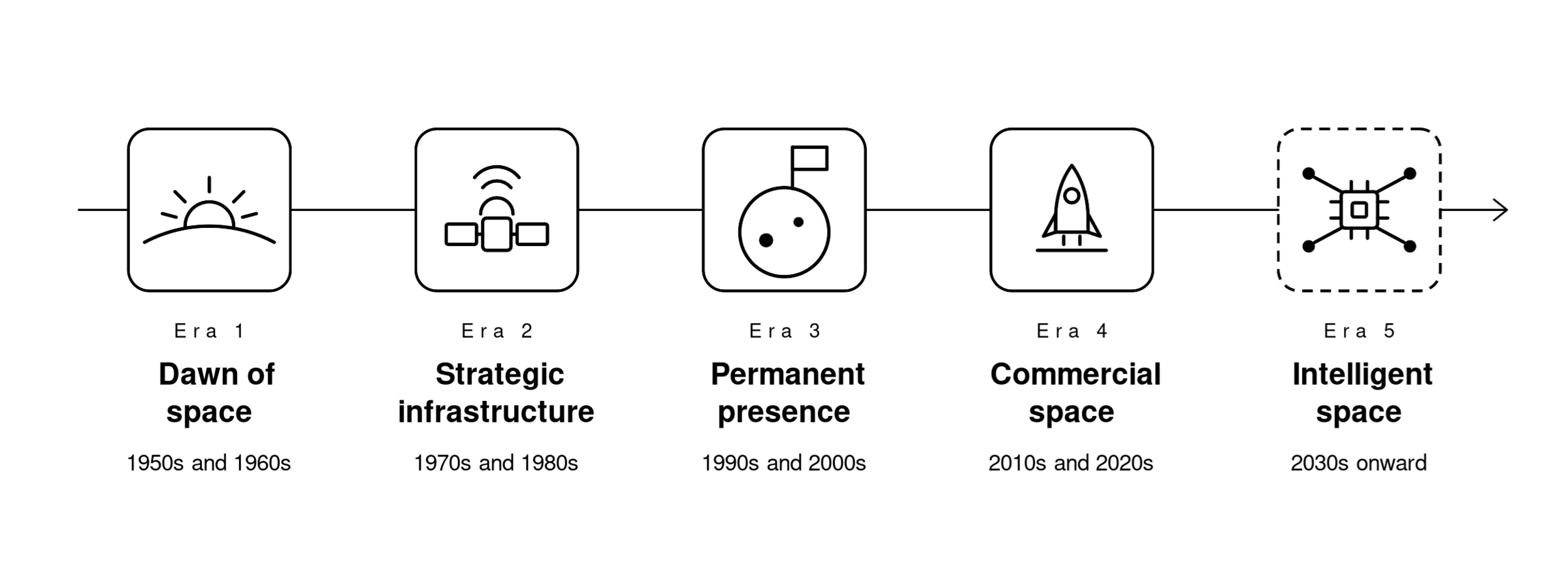
Spaceflight is usually narrated through its firsts. This article reads it through intent instead, asking what people were trying to do with space at any given moment, and divides it into five eras of roughly twenty years. The first, across the 1950s and 1960s, treated space as proof of concept and national prestige: every launch was a demonstration that something could be done at all. The second, through the 1970s and 1980s, made it load-bearing infrastructure for communication, navigation, Earth observation and reconnaissance, built for function rather than for attention. The third, across the 1990s and 2000s, turned space into somewhere people and their machines stay rather than visit, from Mir and the ISS to a continuous robotic presence at Mars. The fourth, in the 2010s and 2020s, made launch a commodity bought off a price list and collapsed the cost of reaching orbit. The fifth, beginning in the 2030s, moves the frontier past access altogether: the question becomes what mass does once it is there, through onboard autonomy, artificial intelligence, dense constellations, and servicing, assembly and manufacturing in orbit. The eras overlap, and the boundaries are arguments rather than dates. This is a lens for noticing when the point of going to space changed, not a claim about where the lines truly fall.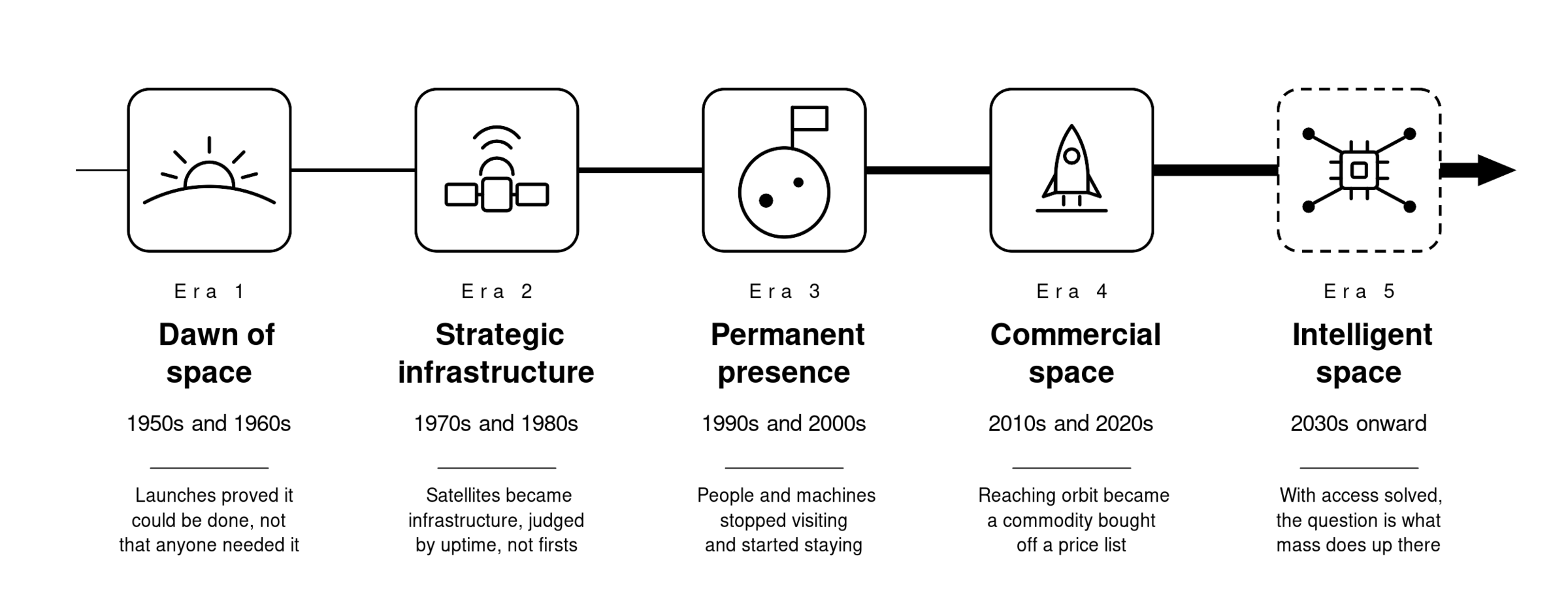
Premise
Over seventy years of space exploration are usually told as a sequence of firsts, with each achievement standing in for the period that produced it. This article takes a different route and reads the space age through what people were trying to do with it, dividing it into five eras of about twenty years. Such division is deliberately coarse and openly subjective, a lens for noticing when the point of going to space changed rather than a claim about where the boundaries truly fall.Naturally, history resists that kind of division, and a few examples show where. Launch vehicles develop continuously rather than in blocks: the Space Shuttle alone operated for thirty years, and the fall in launch cost that characterises the fourth era grew out of decisions taken well before it. Systems can also be conceived in one period and matter most in another, as with GPS, approved in the 1970s, fully operational only in the 1990s, and commercially dominant later still. Others sit outside the scheme entirely. Voyager 1, launched in 1977 and still returning data as of the time of writing [1], defined no twenty-year block and was no less important for it.
There are, of course, many more examples that resist this division. The five eras should therefore be read as a coarse overview of where space systems have been, and where they may be heading, rather than a definitive account of space history. The boundaries are open to discussion, as are the missions and technologies that deserve to be included. What important developments have been missed? Which missions changed how a generation saw space? And which seemingly minor developments may prove to have shaped the next era? These are questions the author leaves open for discussion.
First Era: Dawn of Space
Overview
1950s and 1960sSpace was proof-of-concept and national prestige, not infrastructure. Every launch was a demonstration that something could be done at all, not a tool anyone was using yet.
To the Earth's Orbit
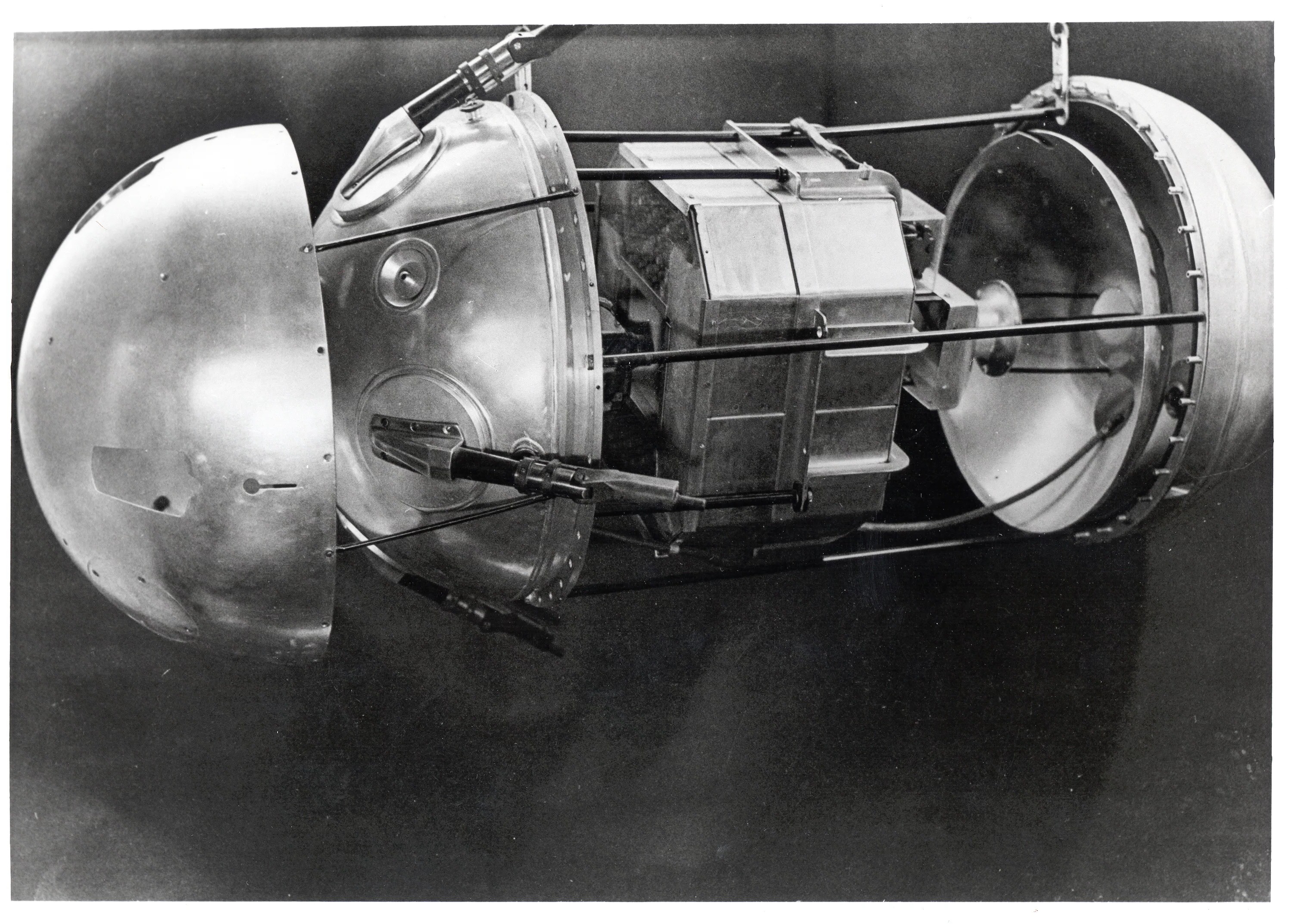
NASA introduced the time period as The Dawn of the Space Age in their Historical Resources, dating it from 4 October 1957, when the Soviet Union launched Sputnik 1 [2]. Their reasoning is worth repeating, because the claim is not simply that Sputnik came first. A sphere 58 cm across, weighing 83.6 kg and circling Earth every 98 minutes, opened political, military, technological, and scientific fronts at once. Within four months, the USA had answered with Explorer 1 and found the Van Allen radiation belts; within twelve months, Congress had passed the National Aeronautics and Space Act and NASA existed [2]. This single launch built the institutions that ran the next fifty years of spaceflight.However, thirteen years before that race began, a German V-2 rocket on a vertical test flight designated MW 18014 became the first human-made object in space [3]. Germany’s rocket programme ended with the war, and its engineers and hardware were divided between the USA and the Soviet Union. Sputnik 1 was the first artificial satellite to orbit Earth rather than merely touch space and fall back [4], and three and a half years later the Soviet Union closed the remaining gap between machine and passenger: on 12 April 1961, Yuri Gagarin rode Vostok 1 into orbit as the first human in space [5].
To the Moon
On 20 July 1969, Apollo 11 put the first humans on the lunar surface [6]. The USA spent $25.8 billion on Apollo between 1960 and 1973, roughly $309 billion in 2025 dollars [7]. No commercial market justified that figure, and none was expected to. What it bought instead is harder to price. Firstly, at its peak the programme employed 400,000 people and drew on hundreds of universities and some 20,000 industrial firms [8]. The engineering did not stay in aerospace. Next, NASA is still tracing everyday technologies back to the programme decades later. Technologies such as digital flight control, food-safety methodology, reflective insulation, or shock damping began as answers to Apollo problems and ended up as commercial solutions [9].Worthy challenges, such as reaching the Moon, gave reason to tackle problems nobody had solved before, producing methods and technologies that outlived the purpose for which they were created. Gisler and Sornette [8] make the sharper version of the point. They read the programme as a societal bubble, a period of collective over-enthusiasm in which institutions and individuals accept risks that standard accounting would reject, and argue that such episodes are how exceptional innovation gets explored at all. The Moon landing was the objective, while the capability built to reach it is what outlasted the programme. Apollo 17 left the Moon in December 1972, and no human has returned in the more than fifty years since; missions 18, 19, and 20 had already been cancelled to save money and to appease a new administration [8].
The Shift Ahead
Notably, by the time Apollo 11 landed in 1969, weather satellites had been operating for years [10], reconnaissance satellites had been returning film [11], satellite navigation had been serving the US Navy [12], and commercial communications satellites had been carrying paid traffic [13]. By the time Apollo 17 left the Moon in 1972, the Space Shuttle had already been approved [14], and its payload bay was already being sized around a reconnaissance satellite [15]. With the end of the Apollo programme, significant budget cuts led to changes in the goals of key space players, marking the end of an era.Second Era: Strategic Infrastructure
Overview
1970s and 1980sSpace stopped being a demonstration and became a utility. Communication, observation and reconnaissance satellites were built for function rather than attention, and judged by whether they kept working rather than by whether they were first.
The Utility Turn
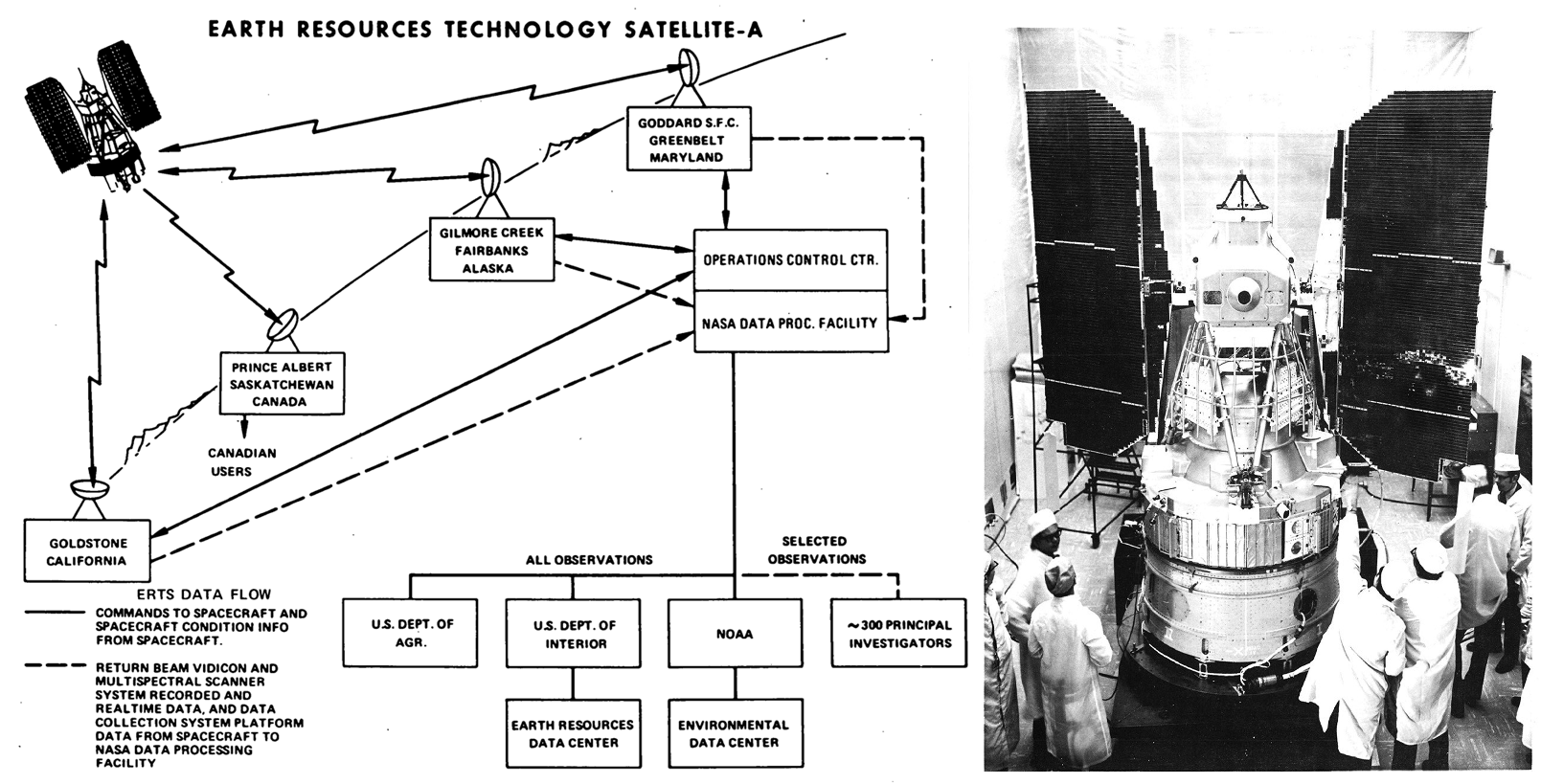
One of the first businesses in orbit was telephony. Intelsat I opened with 240 voice circuits between the USA and Europe, and by the Intelsat IV series that had grown to 6,000, carried alongside television [16]. On 30 September 1975, HBO broadcast a live heavyweight boxing match between Muhammad Ali and Joe Frazier from Manila to cable subscribers across the USA. The television signal was sent up to Westar 1, which relayed it back down over the entire country at once. Local cable companies picked it up on dish antennas and carried it to their customers, who were effectively paying for space services [17].Landsat satellites surveyed the Earth’s land surface on a repeating cycle, returning to each area every few weeks. The record they built showed how forests, farmland, water and cities changed over time, and the United States sold the imagery at prices meant to cover distribution rather than to make money [18]. Later, the Land Remote-Sensing Commercialization Act of 1984 authorised the transition of Landsat to a private operator with a federal subsidy of $250 million [19]. The price of a single image rose as high as $4,400, and orders fell, even as computing power and geographic information systems were expanding the potential market [20]. In 1992 Congress cancelled the 1984 law and put Landsat back under government control [21].
Reconnaissance and Arms Control
Space infrastructure was key not only to commerce but also to the military. Neither the USA nor the Soviet Union would let the other’s inspectors onto its territory, so each counted the other’s missiles from orbit instead. Corona, the early American system, ejected exposed film in capsules that aircraft caught in mid-air, so the pictures arrived days after they were taken [11]. The KH-11, first launched in December 1976, replaced film with electronic sensors and sent its images down as data [22].Both governments then wrote the arrangement into a treaty. The 1972 ABM Treaty states that each party will verify compliance using its own national technical means, and that neither will interfere with the other’s [23]. Notably, the programme doing the photographing stayed secret until 1995 [11]. Military use of space has grown continuously since, and is no longer particular to one country.
The Shift Ahead
GPS was approved in 1973 and first launched in 1978, but did not reach full operational capability until 1995 [24], so this era paid for a system whose returns arrived long after it ended. The International Space Station (ISS) had a similar history. In July 1975, an Apollo and a Soyuz spacecraft docked in orbit, the first international human spaceflight and the first time the two rivals worked together rather than against each other [25]. Mir followed in 1986 and was occupied continuously from September 1989 [26], and the hull that now forms the core of the ISS’s Russian segment was built in the mid-1980s [27].Third Era: Permanent Presence
Overview
1990s and 2000sSpace stopped being somewhere you visit and became somewhere people, or their machines, remain. The achievement was no longer arrival but continuity, which made permanence a logistics problem rather than an engineering one.
Staying in Orbit
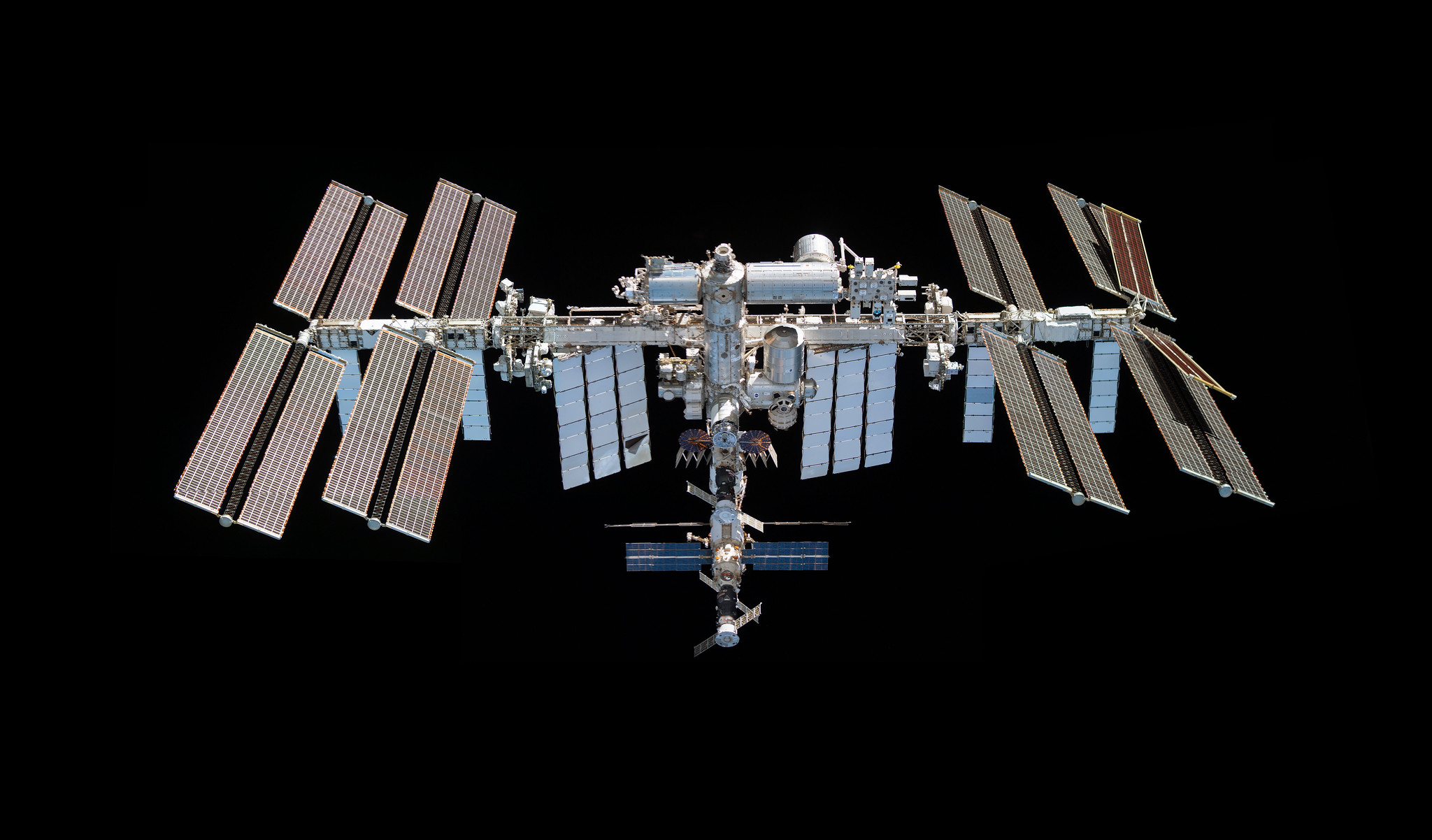
Between 1994 and 1998, American Space Shuttles docked with Mir nine times, and seven American astronauts spent close to a thousand days living aboard a Russian station [28]. On 29 January 1998, fifteen governments signed the agreement that still governs the ISS: the USA, Russia, Canada, Japan and eleven European states [29]. Excluded on American national security grounds, China built its own capability and became the third country to put a human in orbit independently when Yang Liwei flew Shenzhou 5 on 15 October 2003 [30].It is worth noting that permanence is a logistics problem. Crews rotate, and although most of the water on board is recovered [31], new cargo is still required. Consequently, it is impressive that Mir was crewed without a break from September 1989 until August 1999 [26], and the ISS has been crewed without a break since 2 November 2000 (at the time of writing) [32]. In the quarter of a century since, there has not been one day when every human being was on Earth.
Going Further
The Voyager probes had already crossed the outer solar system in the previous era, but they passed through. This era arrived and stayed. On 7 December 1995, Galileo became the first spacecraft to orbit an outer planet, and the probe it released made the first direct measurements inside Jupiter’s atmosphere [33]. On 14 January 2005, the European probe Huygens descended by parachute through the atmosphere of Titan and landed on Saturn’s largest moon [34].Mars exploration by human-made space systems followed a pattern similar to that established by Mir and the ISS. As of the time of writing, since 1997, at least one operational spacecraft has been present at Mars at all times, either on its surface or in orbit [35]. One notable example is the Opportunity rover, which was designed to operate for three months and travel 1 km, but ultimately operated for fifteen years and travelled 45 km [36]. More broadly, robotic exploration evolved from periodic visits to a continuous human-made presence beyond Earth, mirroring the transition from short-duration missions to permanent habitation in the low Earth Orbit (LEO).
The Shift Ahead
Notably, the commercial era was already visible before this one closed. On 4 October 2004, SpaceShipOne won the Ansari X Prize by carrying a crew to space twice within two weeks on private funding [37]. In 2006, NASA launched the Commercial Orbital Transportation Services programme. Instead of designing and owning the cargo launch vehicles itself, as it had been for decades, NASA paid private companies fixed-price contracts to develop their own vehicles and sell them as a delivery service to the ISS [38]. On 28 September 2008, Falcon 1 became the first privately developed liquid-fuelled rocket to reach orbit, carrying a payload mass simulator of approximately 165 kg [39]. The change was as much in engineering as in procurement and approach to making business, and it set the terms for the era that followed.Fourth Era: Commercial Space
Overview
2010s and 2020sLaunch stopped being a scarce, state-run capability and became a commercial commodity you buy off a price list. Along with that, the process of so-called space democratisation begins.
Launch Opportunities
One of the defining characteristics of the fourth era was increasingly cheap and frequent access to orbit. The Space Shuttle illustrates how difficult that objective proved to achieve. Although the system recovered and reflown its orbiter, main engines, and solid rocket boosters after each mission, the Space Shuttle completed 135 missions between 1981 and 2011 without delivering the anticipated economic benefits of reusability [40]. Each orbiter required between 100 and 130 days and more than 750,000 work hours of inspection and refurbishment between flights, compared with the original design objective of only 160 working hours [41][42].Falcon 9, first launched on 4 June 2010, was the first launch system to translate reusability into a substantial reduction in launch cost [43]. According to Jones, the cost of delivering payloads to LEO decreased from approximately $61,700/kg for the Space Shuttle to approximately $2,720/kg for Falcon 9, expressed in constant 2018 dollars [44]. Elon Musk has also stated a long-term target of $100 to $200/kg for Starship if full reusability is achieved, although this figure has not yet been confirmed in an official SpaceX publication [45]. The impact of this reduction is reflected in launch activity: SpaceX conducted 165 of the world’s 324 orbital launches in 2025, representing 51 percent of the global total [46]. By comparison, the Space Shuttle’s highest annual flight rate was nine missions in 1985 [47].
Miniaturisation, COTS and Standardisation
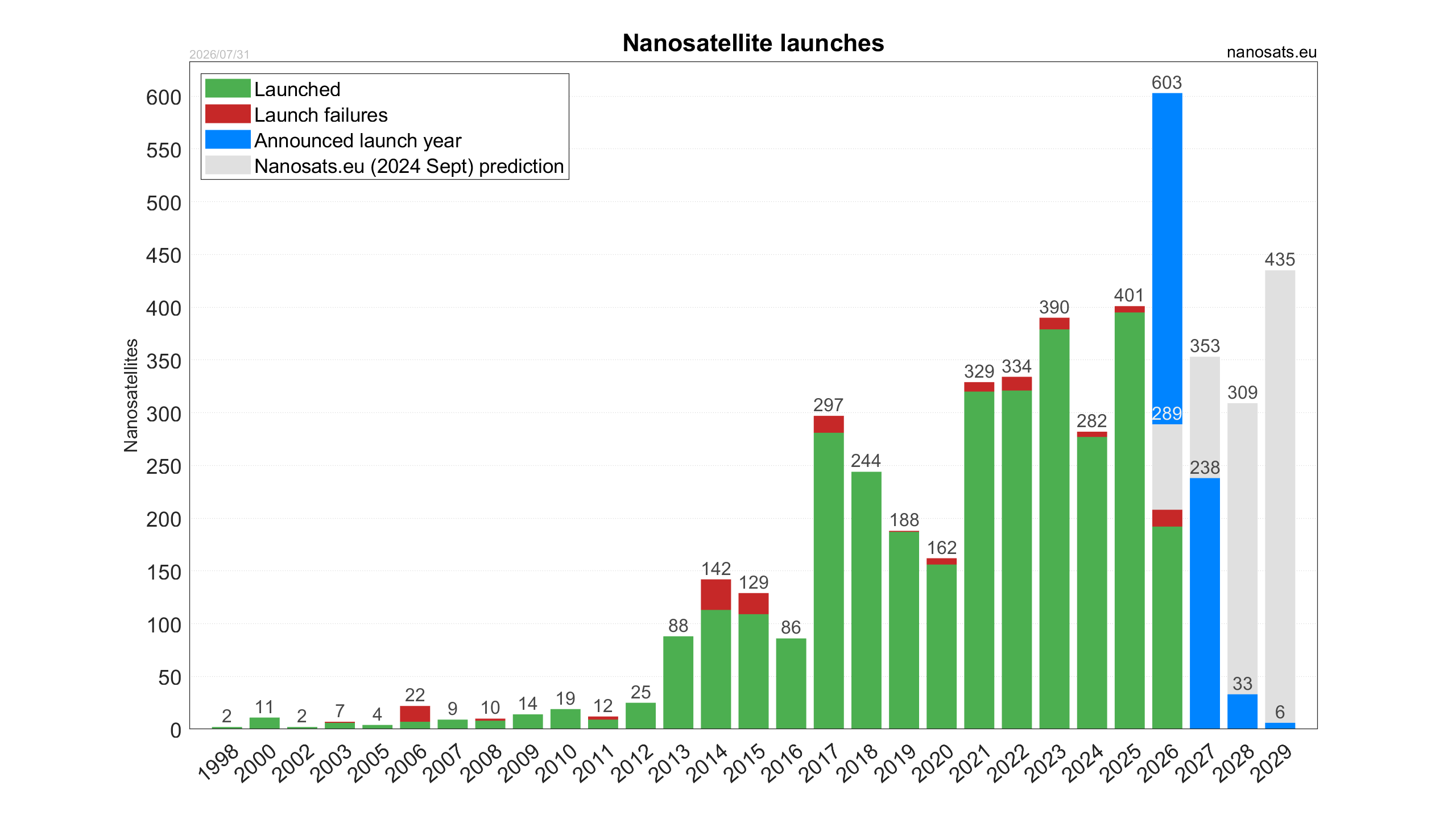
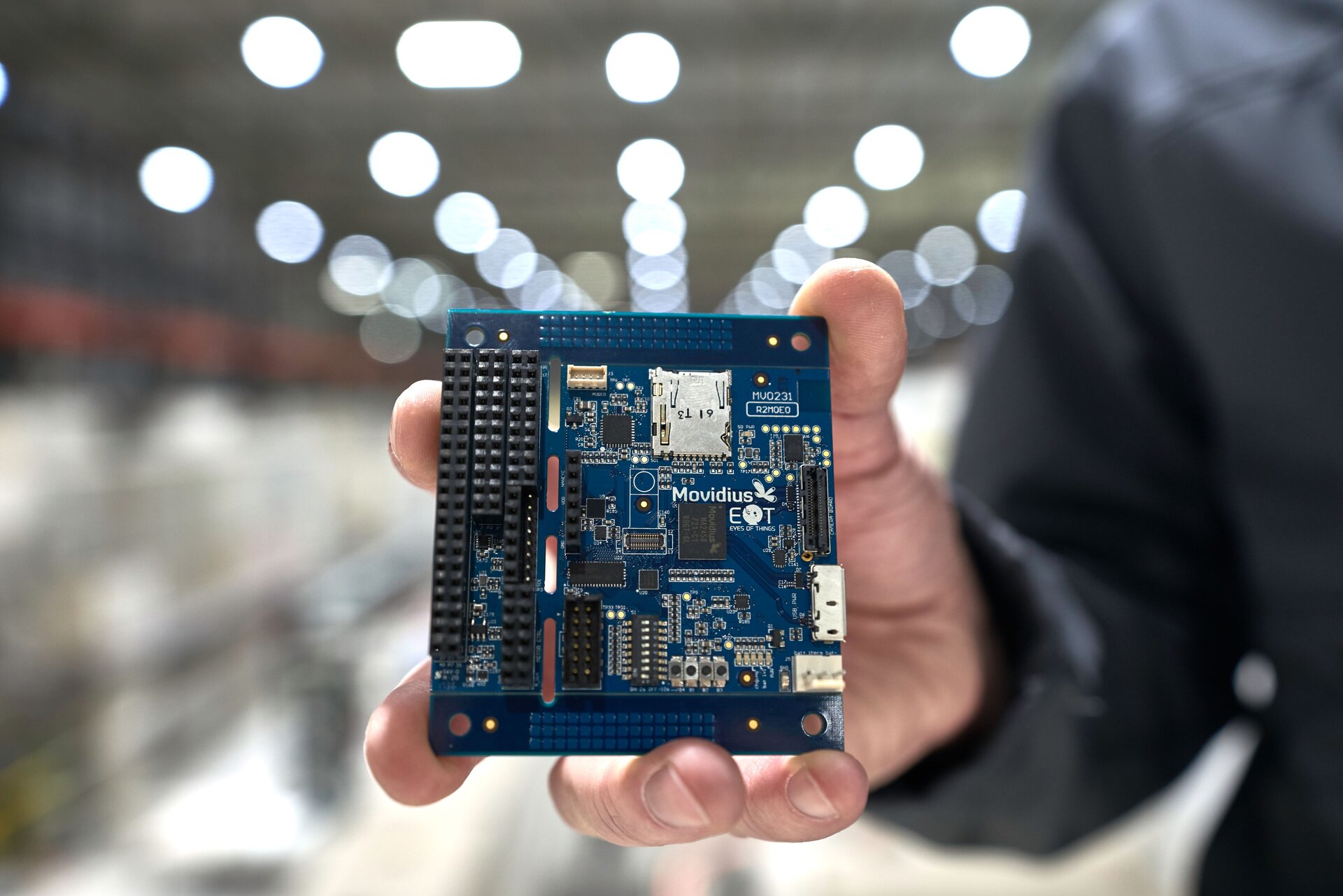
The other half of the cost collapse happened on the payload side, and it came from consumer electronics rather than aerospace. Commercial off-the-shelf (COTS) processors, sensors and radios were smaller, cheaper and drew less power than space-qualified equivalents. A capable satellite could now be built by a small team with modest facilities and flown as a secondary payload [48]. As shown in the figure above, this marks the rise of small satellites, notably nanosatellites (1 kg to 10 kg).However, it was more standardisation than miniaturisation that turned a satellite into something an organisation could buy rather than a programme it had to run. Namely, the CubeSat, defined in 1999 at California Polytechnic State University and Stanford University as a 1U cube of 10 cm x 10 cm x 11.35 cm, began as a teaching project and became a standard only through adoption [49]. The decisive part was that the Poly-Picosatellite Orbital Deployer presents the same interface to the rocket, whatever it holds, so a small payload stopped imposing integration risk on the mission paying for the flight [48].
Private Space Market
Arguably, the value that marks this era is not where the hardware is. In 2025, spacecraft manufacturing and launch together were worth 75 billion euros. The services carried on them were worth 489 billion, three-quarters of that global navigation satellite systems (GNSS). Upstream is the enabling layer, and the smaller one by a factor of six, with public customers accounting for 80 percent of its value, defence alone for 42 percent. What changed is who funds the suppliers. Private investment reached a record 11.7 billion euros across 324 deals, up 60 percent on 2024. The increase was entirely American, with US ventures up 177 percent while Europe, China and Japan all declined [46].Notably, that capital concentrated the market rather than widening it. The launch segment alone absorbed 41 percent of disclosed private funding worldwide over the past five years, and Starlink now holds roughly 9,300 of the 15,000 active satellites in orbit. Because SpaceX builds and launches its own constellation, that volume barely reaches the open market: between vertical integration and captive defence programmes, European suppliers capture only 10 percent of global upstream value [46].
The Shift Ahead
The next constraint is not about reaching orbit but about what happens there. Onboard autonomy is the first sign. KP Labs’ Intuition-1, a 6U CubeSat launched in November 2023, runs neural networks on its own hyperspectral imagery and is designed to cut the volume it sends to the ground by about a hundredfold [50]. The fleet that could carry such workloads already exists: of the roughly 15,000 active satellites in orbit at the end of 2025, 76 percent sit in LEO and 84 percent belong to commercial operators, financed to sell connectivity rather than computation [46]. Artemis points towards a similar inversion in exploration and could help open the Moon to sustained commercial activity, with lunar landers increasingly procured as commercial services [51], while the launch vehicle and crew capsule remain conventional national programmes [52].Fifth Era: Intelligent Space
Overview
2030s and beyondReaching orbit stopped being the constraint, and what mass does once it is there became the question. Autonomy, onboard processing and self-servicing infrastructure are still leading indicators rather than an operating industry, which is why this era is dated forward rather than claimed as already here.
Moon to Mars and Beyond
On 1 April 2026, Artemis II carried four astronauts around the Moon and back, the first crewed lunar flyby in more than fifty years, reaching 406,771 km from Earth and passing the distance record Apollo 13 set in 1970 [53][54]. Artemis III, the designation once reserved for the landing, became a 2027 rendezvous and docking test with commercial landers in LEO; the landing moved to Artemis IV in 2028 [55]. Importantly, Artemis is the first step of a longer plan rather than the plan itself. NASA’s Moon to Mars Architecture divides the campaign into four segments, Human Lunar Return, Foundational Exploration, Sustained Lunar Evolution and Humans to Mars, which build on one another but are developed in parallel, so that Mars-forward work is carried out during the lunar segments [56].Naturally, Artemis is the segment that is already resourced. The architecture-driven technology gaps concentrate entirely in Foundational Exploration, Sustained Lunar Evolution and Humans to Mars [56]. That distribution points two ways at once. One is a race: NASA justified compressing the schedule by citing credible competition from a geopolitical adversary [55], and China holds to a crewed landing before 2030 [57]. The other is preparation, since the lunar segments are explicitly the testbed for the systems, human adaptations and technologies that Mars will demand [56].
Artificial Intelligence in Space
Onboard autonomy began as a bandwidth problem rather than a compute one. Phi-Sat-1, launched on 3 September 2020, was the first demonstrator of a deep neural network running on board a satellite Earth observation mission, discarding cloud-covered hyperspectral frames before they consumed downlink [58], and Intuition-1 extended the principle to full onboard processing [50]. The satellite is not smarter in any general sense; it decides what is worth sending. Sensors have outgrown the pipe to the ground, and moving the decision to the sensor is the cheapest available fix.The second development inverts that relationship and makes compute the payload. In February 2026, SpaceX acquired xAI and filed with the FCC for up to one million solar-powered satellites operating as orbital data centres [46], while Google’s Project Suncatcher proposes clusters of 81 satellites flying within a 1 km radius at 650 km, linked by free-space optics [59]. The constraint is thermodynamic. Vacuum removes convection, so waste heat must leave as infrared radiation, and shedding 10 MW requires a radiator area comparable to two football fields [60][61]. GAO notes that the arrays involved exceed anything launched and assembled in space to date, and that the earliest viable customers are latency-tolerant workloads already in orbit, such as Earth observation and intelligence processing [62]. The announced ambition is a general-purpose orbital compute layer; the defensible near-term case is processing data that is already up there.
Satellite Constellations
Constellations have a major impact on the current orbital environment. Roughly 15,000 active satellites were in orbit at the end of 2025, of which Starlink alone accounted for about 9,300, and 64 percent of the year’s launches were dedicated to constellation payloads, 43 percent to mega-constellations and 21 percent to traditional systems such as GPS. The pipeline is not closing; as of early December 2025, China had announced 114 commercial constellation plans [46]. Not all of that capacity is aimed at connectivity or computation: the EU’s EuroQCI initiative is working towards a quantum-secured communications layer in orbit, with ESA and SES’s Eagle-1, Europe’s first satellite quantum key distribution mission, due to fly in late 2026 or early 2027 [63].At the altitudes constellations prefer, the density of active payloads now approaches that of debris, and ESA flags the 400 km to 600 km band as needing continuous traffic coordination rather than case-by-case warnings [64]. Constellation operators are, to be fair, the better-behaved half of the problem: between 86 percent and 99 percent of payloads under 1000 kg reaching end of life since 2020 sit in orbits that decay within twenty-five years, against 57 percent for heavier spacecraft [64]. Constellations will therefore increase both the number of satellites in orbit and the need to coordinate them. Whether that coordination stays on the ground is unresolved; Suncatcher already proposes holding formation with AI [59], and denser fleets may make onboard autonomy the practical option.
In-Space Servicing, Assembly, and Manufacturing
In-space servicing, assembly and manufacturing (ISAM) covers the work of maintaining, building and refuelling hardware once it is already in orbit [65]. Servicing has one unambiguous precedent. On 25 February 2020, Northrop Grumman’s Mission Extension Vehicle-1 docked with Intelsat 901, the first docking between two commercial satellites and the first with a spacecraft never designed for it [66]. The direction of travel since has been away from government demonstrators and towards purchased services, with NASA cancelling its own flagship servicing mission in 2024 and contracting commercial operators instead [67][68][69]. Manufacturing is further behind. The first metal part printed aboard the ISS dates only to August 2024, and processes that are routine on the ground remain immature in microgravity and vacuum [70].The case for ISAM rests on three problems with how spacecraft are built today. They have to fit inside a launcher, they are often retired when they run out of fuel even if their hardware still works, and every kilogram must first be launched from Earth. ISAM addresses these limits by allowing systems to be assembled, refuelled, repaired, upgraded, or manufactured in space [65][70]. NASA’s Moon to Mars architecture already asks that systems be designed, where practical, for reuse and recycling to increase Earth independence [56]. The nearer test might be commercial with orbital data centres, which might be difficult to launch in one piece [62].
Discussion
- Era 1: does exceptional capability require an uneconomic goal? Apollo bought capability that no market would have funded, and the spinoffs are almost always cited afterwards rather than promised in advance. If collective over-enthusiasm is how radical innovation gets explored at all, then the economic justification is a rationalisation rather than a reason. What plays that role now, and is Artemis it?
- Era 2: who should own infrastructure whose returns arrive decades later? Some systems of this era were handed to the market and priced to recover their cost, and demand collapsed; others stayed public and free at the point of use, and became the foundation of an industry worth more than the hardware that carries it. What decides which model fits a given system, and which of today's space assets is being priced the wrong way?
- Era 3: is continuity worth paying for in itself? Continuous human presence in orbit and continuous robotic presence at Mars are both by-products of overlapping programmes rather than of any policy that set out to sustain them. Nobody has had to defend the streak as a line item, because nobody has yet been asked to. If a gap opens, does anything real change, or is continuity a record we have mistaken for an objective?
- Era 4: is this a market yet? Demand upstream remains largely public and heavily defence-weighted, most of the active fleet belongs to an operator that launches it on its own rockets, and private capital concentrates in a handful of firms. A market with captive supply and public demand is not obviously a market. Does competition arrive, or does the cost curve flatten once it no longer has to fall?
- Era 5: which constraint actually defines it? Three candidates are live, and they imply different industries: autonomy, where the satellite decides what is worth sending; orbital compute, where the binding limit is heat rather than silicon; and coordination, where crowded orbits become a governance problem before they become a technical one. Which one turns out to be binding, and is it settled by engineering or by regulation?
Key 5 Facts
- Era 1: Apollo cost the USA $25.8 billion between 1960 and 1973, roughly $309 billion in 2025 dollars, and employed 400,000 people at its peak. No commercial market justified that figure, and none was expected to.
- Era 2: GPS was approved in 1973 and reached full operational capability only in 1995. The era that paid for it had ended before it worked.
- Era 3: Someone has been living off Earth continuously since 2 November 2000. In the quarter of a century since, there has not been one day when every human being was on the planet.
- Era 4: The cost of reaching LEO fell from roughly $61,700/kg on the Space Shuttle to roughly $2,720/kg on Falcon 9, in constant 2018 dollars. SpaceX flew 165 of the world's 324 orbital launches in 2025.
- Era 5: Of the roughly 15,000 active satellites in orbit at the end of 2025, about 9,300 were Starlink. SpaceX has since filed for up to one million more, to be run as orbital data centres, although shedding 10 MW of waste heat in vacuum needs a radiator area comparable to two football fields.
References
- National Aeronautics and Space Administration (NASA), "NASA Shuts Off Instrument on Voyager 1 to Keep Spacecraft Operating," NASA Science, Voyager Blog, April 2026. https://science.nasa.gov/blogs/voyager/2026/04/17/nasa-shuts-off-instrument-on-voyager-1-to-keep-spacecraft-operating/
- National Aeronautics and Space Administration (NASA), "The Dawn of the Space Age." https://www.nasa.gov/history/dawn-of-the-space-age/
- Orbital Today, "First Man-Made Object in Space: Myths and Facts Explained," 2022. https://orbitaltoday.com/2022/09/20/first-man-made-object-in-space-myths-facts-explained/
- National Aeronautics and Space Administration (NASA), "65 Years Ago: Sputnik Ushers in the Space Age," 2022. https://www.nasa.gov/history/65-years-ago-sputnik-ushers-in-the-space-age/
- National Aeronautics and Space Administration (NASA), "An Historic Day in Human Spaceflight," 2021. https://www.nasa.gov/image-article/an-historic-day-human-spaceflight/
- National Aeronautics and Space Administration (NASA), "Apollo 11," 2019. https://www.nasa.gov/mission/apollo-11/
- The Planetary Society, "How Much Did the Apollo Program Cost?," 2025. https://www.planetary.org/space-policy/cost-of-apollo
- M. Gisler and D. Sornette, "Exuberant Innovations: The Apollo Program," Society, vol. 46, no. 1, pp. 55-68, 2009. doi: 10.1007/s12115-008-9163-8. https://doi.org/10.1007/s12115-008-9163-8
- M. DiCicco, "Going to the Moon Was Hard, But the Benefits Were Huge, for All of Us," NASA, Technology Transfer and Spinoffs, July 2019. https://www.nasa.gov/technology/tech-transfer-spinoffs/going-to-the-moon-was-hard-but-the-benefits-were-huge-for-all-of-us/
- National Aeronautics and Space Administration (NASA), "TIROS," NASA Science. https://science.nasa.gov/mission/tiros/
- National Reconnaissance Office, "The CORONA Program." https://www.nro.gov/About-NRO/history/history-corona/
- Johns Hopkins University Applied Physics Laboratory, "Transit: The Navy Navigation Satellite System." https://sd-www.jhuapl.edu/Transit/
- Intelsat, "Meet Intelsat 1," Intelsat, Our Story. https://www.intelsat.com/homepage/about-us/our-story/meet-intelsat-1/
- R. M. Nixon, "Statement Announcing Decision to Proceed with Development of the Space Shuttle," NASA History Office, January 1972. https://www.hq.nasa.gov/office/pao/History/stsnixon.htm
- National Aeronautics and Space Administration (NASA), "50 Years Ago: President Nixon Directs NASA to Build the Space Shuttle," NASA History, 2022. https://www.nasa.gov/history/50-years-ago-president-nixon-directs-nasa-to-build-the-space-shuttle/
- Engineering and Technology History Wiki, "Communications Technologies," IEEE History Center. https://ethw.org/Communications_Technologies
- R. T. Umstead, "The Fight That Helped Cable Take Flight," Multichannel News / Next TV. https://www.nexttv.com/news/fight-helped-cable-take-flight-394103
- National Aeronautics and Space Administration (NASA), "Landsat Science," NASA Goddard Space Flight Center. https://landsat.gsfc.nasa.gov/
- "Land Remote-Sensing Commercialization Act of 1984," Public Law 98-365, 15 U.S.C. ch. 68, 1984. https://uscode.house.gov/view.xhtml?path=/prelim@title15/chapter68&edition=prelim
- Congressional Research Service, "Landsat: Overview and Issues for Congress," Congressional Research Service, Rep. R40594. https://www.everycrsreport.com/reports/R40594.html
- "Land Remote Sensing Policy Act of 1992," S. 2297, 102nd Congress, 1992. https://www.congress.gov/bill/102nd-congress/senate-bill/2297
- GlobalSecurity.org, "KH-11 KENNEN." https://www.globalsecurity.org/space/systems/kh-11.htm
- "Treaty Between the United States of America and the Union of Soviet Socialist Republics on the Limitation of Anti-Ballistic Missile Systems," U.S. Department of State, Article XII, 1972. https://2009-2017.state.gov/t/avc/trty/101888.htm
- The Aerospace Corporation, "A Brief History of GPS." https://aerospace.org/article/brief-history-gps
- National Aeronautics and Space Administration (NASA), "Apollo-Soyuz Test Project." https://www.nasa.gov/apollo-soyuz-test-project/
- European Space Agency, "Honourable Discharge for Mir Space Station." https://www.esa.int/Science_Exploration/Human_and_Robotic_Exploration/Honourable_discharge_for_Mir_space_station
- M. Wade, "ISS Zvezda," Encyclopedia Astronautica. http://www.astronautix.com/i/isszvezda.html
- National Aeronautics and Space Administration (NASA), "Shuttle-Mir." https://www.nasa.gov/space-shuttle/shuttle-mir
- "Agreement Among the Government of Canada, Governments of Member States of the European Space Agency, the Government of Japan, the Government of the Russian Federation, and the Government of the United States of America Concerning Cooperation on the Civil International Space Station," signed 29 January 1998. https://www.esa.int/About_Us/ECSL_-_European_Centre_for_Space_Law/International_Space_Station_Intergovernmental_Agreement
- China Manned Space Agency, "Shenzhou V." https://en.cmse.gov.cn/missions/shenzhouv/
- T. Pultarova, "NASA Just Recycled 98% of All Astronaut Pee and Sweat on the ISS," Space.com, 2023. https://www.space.com/astronaut-pee-iss-water-recycling-98-percent-milestone
- National Aeronautics and Space Administration (NASA), "International Space Station Facts and Figures." https://www.nasa.gov/international-space-station/space-station-facts-and-figures/
- National Aeronautics and Space Administration (NASA), "Galileo," NASA Science. https://science.nasa.gov/mission/galileo/
- European Space Agency, "Celebrating the Fifth Anniversary of Huygens' Titan Touchdown." https://www.esa.int/Science_Exploration/Space_Science/Cassini-Huygens/Celebrating_the_fifth_anniversary_of_Huygens_Titan_touchdown
- National Aeronautics and Space Administration (NASA), "25 Years of Continuous Robotic Mars Exploration: From Pathfinder to Perseverance," NASA History. https://www.nasa.gov/history/25-years-of-continuous-robotic-mars-exploration-from-pathfinder-to-perseverance/
- Cornell University, "Built to Last 90 Days, Mars Rover Opportunity Ends Mission After 15 Years," Cornell Chronicle, 2019. https://news.cornell.edu/stories/2019/02/built-last-90-days-mars-rover-opportunity-ends-mission-after-15-years
- XPRIZE Foundation, "Ansari XPRIZE." https://www.xprize.org/competitions/ansari
- National Aeronautics and Space Administration (NASA), "Commercial Orbital Transportation Services Demonstrations," NASA Technical Reports Server, 20060050052, 2006. https://ntrs.nasa.gov/citations/20060050052
- SpaceNews, "SpaceX Successfully Launches Falcon 1 to Orbit," 2008. https://spacenews.com/spacex-successfully-launches-falcon-1-to-orbit/
- National Aeronautics and Space Administration (NASA), "10 Years Ago: STS-135, the Space Shuttle's Grand Finale," 2021. https://www.nasa.gov/history/10-years-ago-sts-135-the-space-shuttles-grand-finale/
- National Aeronautics and Space Administration, Kennedy Space Center, "Orbiter Processing Facility." https://science.ksc.nasa.gov/facilities/opf.html
- National Aeronautics and Space Administration (NASA), "Requirements for Space Shuttle Systems," NASA Technical Reports Server, Rep. 19700030294, 1970. https://ntrs.nasa.gov/api/citations/19700030294/downloads/19700030294.pdf
- Space.com, "Happy Birthday, Falcon 9! SpaceX's Workhorse Rocket Debuted 10 Years Ago Today," 2020. https://www.space.com/spacex-first-falcon-9-rocket-launch-10-years.html
- H. W. Jones, "The Recent Large Reduction in Space Launch Cost," in Proc. 48th Int. Conf. Environmental Systems (ICES-2018-81), Albuquerque, NM, USA, 2018. NASA Ames Research Center, NTRS 20200001093. https://ntrs.nasa.gov/citations/20200001093
- E. Musk, "Statement Following Starship Flight 12," May 2026. As reported by SpaceOrbitals. https://spaceorbitals.com/articles/starship-v3-cost-per-kg-2026/
- European Space Agency, "Report on the Space Economy 2026," European Space Agency, p. 19, 2026. https://space-economy.esa.int/documents/ESA%20Report%20on%20the%20Space%20Economy%202026%20-%20public_6a54dcb2dc6f2.pdf
- National Aeronautics and Space Administration (NASA), "40 Years Ago: STS-51C, the First Dedicated Department of Defense Shuttle Mission," 2025. https://www.nasa.gov/centers-and-facilities/johnson/40-years-ago-sts-51c-the-first-dedicated-department-of-defense-shuttle-mission/
- M. N. Sweeting, "Modern Small Satellites: Changing the Economics of Space," Proceedings of the IEEE, vol. 106, no. 3, pp. 343-361, March 2018. doi: 10.1109/JPROC.2018.2806218
- The CubeSat Program, "CubeSat Design Specification (1U-12U) Rev. 14.1," California Polytechnic State University, San Luis Obispo, Rep. CP-CDS-R14.1, February 2022. https://www.cubesat.org/cubesatinfo
- KP Labs, "Intuition-1: Processing of Hyperspectral Images in Orbit," 2024. https://www.kplabs.space/projects-and-missions/intuition-1
- National Aeronautics and Space Administration (NASA), "NextSTEP-2 H: Human Landing System." https://www.nasa.gov/humans-in-space/nextstep-h-human-landing-system/
- NASA Office of Inspector General, "NASA's Management of the Human Landing System Contracts," NASA Office of Inspector General, Rep. IG-26-004, 2026. https://oig.nasa.gov/audits/nasas-management-of-the-human-landing-system-contracts/
- National Aeronautics and Space Administration (NASA), "Liftoff! NASA Launches Astronauts on Historic Artemis Moon Mission," NASA Release 26-026, April 2026. https://www.nasa.gov/news-release/liftoff-nasa-launches-astronauts-on-historic-artemis-moon-mission/
- National Aeronautics and Space Administration (NASA), "NASA Welcomes Record-Setting Artemis II Moonfarers Back to Earth," April 2026. https://www.nasa.gov/news-release/nasa-welcomes-record-setting-artemis-ii-moonfarers-back-to-earth/
- National Aeronautics and Space Administration (NASA), "NASA Adds Mission to Artemis Lunar Program, Updates Architecture," NASA Release 26-022, February 2026. https://www.nasa.gov/news-release/nasa-adds-mission-to-artemis-lunar-program-updates-architecture/
- National Aeronautics and Space Administration (NASA), "Moon to Mars Architecture Definition Document," NASA Exploration Systems Development Mission Directorate, Rep. NASA/TP-20250010956, ESDMD-001 Revision C, December 2025. https://www.nasa.gov/moontomarsarchitecture-architecturedefinitiondocuments/
- A. Jones, "China on Track for Crewed Moon Landing by 2030, Space Official Says," SpaceNews, 2025. https://spacenews.com/china-on-track-for-crewed-moon-landing-by-2030-space-official-says/
- G. Giuffrida, L. Fanucci, G. Meoni, M. Batic, L. Buckley, A. Dunne, C. van Dijk, M. Esposito, J. Hefele, N. Vercruyssen, G. Furano, M. Pastena, and J. Aschbacher, "The Phi-Sat-1 Mission: The First On-Board Deep Neural Network Demonstrator for Satellite Earth Observation," IEEE Transactions on Geoscience and Remote Sensing, vol. 60, pp. 1-14, 2022, Art. no. 5517414. doi: 10.1109/TGRS.2021.3125567. https://doi.org/10.1109/TGRS.2021.3125567
- B. Agüera y Arcas, T. Beals, M. Biggs, J. V. Bloom, T. Fischbacher, K. Gromov, U. Köster, R. Pravahan, and J. Manyika, "Towards a Future Space-Based, Highly Scalable AI Infrastructure System Design," Google, 2025. Project Suncatcher preprint. https://services.google.com/fh/files/misc/suncatcher_paper.pdf
- S. Bilén and W. Zuo, "Building Data Centers in Space Is an Intriguing Idea on Paper, but Major Engineering Challenges Must Be Solved," The Conversation, June 2026. https://theconversation.com/building-data-centers-in-space-is-an-intriguing-idea-on-paper-but-major-engineering-challenges-must-be-solved-284053
- A. Aili, J. Choi, Y. S. Ong, and Y. Wen, "The Development of Carbon-Neutral Data Centres in Space," Nature Electronics, vol. 8, no. 11, pp. 1016-1026, 2025. doi: 10.1038/s41928-025-01476-1. https://doi.org/10.1038/s41928-025-01476-1
- U.S. Government Accountability Office, "Science & Tech Spotlight: Data Centers in Space," U.S. Government Accountability Office, Rep. GAO-26-109012, April 2026. https://www.gao.gov/products/gao-26-109012
- European Space Agency, "Eagle-1," ESA Connectivity and Secure Communications. https://www.esa.int/Applications/Connectivity_and_Secure_Communications/Eagle-1
- European Space Agency Space Debris Office, "ESA's Annual Space Environment Report," ESA ESOC, Rep. GEN-DB-LOG-00288-OPS-SD, Issue 10.0, May 2026. https://www.sdo.esoc.esa.int/environment_report/Space_Environment_Report_latest.pdf
- D. D. Arney et al., "In-Space Servicing, Assembly, and Manufacturing (ISAM) State of Play, 2025 Edition," NASA Langley Research Center, Rep. NTRS 20250008988, 2025. https://ntrs.nasa.gov/api/citations/20250008988/downloads/NASA_ISAM_State_of_Play_2025_Edition.pdf
- J. Foust, "Northrop Grumman's MEV-1 Servicer Docks with Intelsat Satellite," SpaceNews, February 2020. https://spacenews.com/northrop-grummans-mev-1-servicer-docks-with-intelsat-satellite/
- J. Foust, "NASA Cancels OSAM-1 Satellite Servicing Technology Mission," SpaceNews, March 2024. https://spacenews.com/nasa-cancels-osam-1-satellite-servicing-technology-mission/
- National Aeronautics and Space Administration (NASA), "NASA Awards Company to Attempt Swift Spacecraft Orbit Boost," 2025. https://www.nasa.gov/news-release/nasa-awards-company-to-attempt-swift-spacecraft-orbit-boost/
- National Aeronautics and Space Administration (NASA), "NASA's Fly Foundational Robots Demo to Bolster In-Space Infrastructure," NASA Goddard Space Flight Center, 2025. https://www.nasa.gov/centers-and-facilities/goddard/nasas-fly-foundational-robots-demo-to-bolster-in-space-infrastructure/
- C. R. Baker, J. B. Hoarston, J. J. Beam, J. T. Roth, T. J. Fleck, J. B. Jordon, and P. G. Allison, "State-of-the-Art Review of Metal In-Space Servicing, Assembly, and Manufacturing (ISAM) Technologies," Acta Astronautica, vol. 245, pp. 788-806, 2026. doi: 10.1016/j.actaastro.2026.03.032. https://doi.org/10.1016/j.actaastro.2026.03.032